
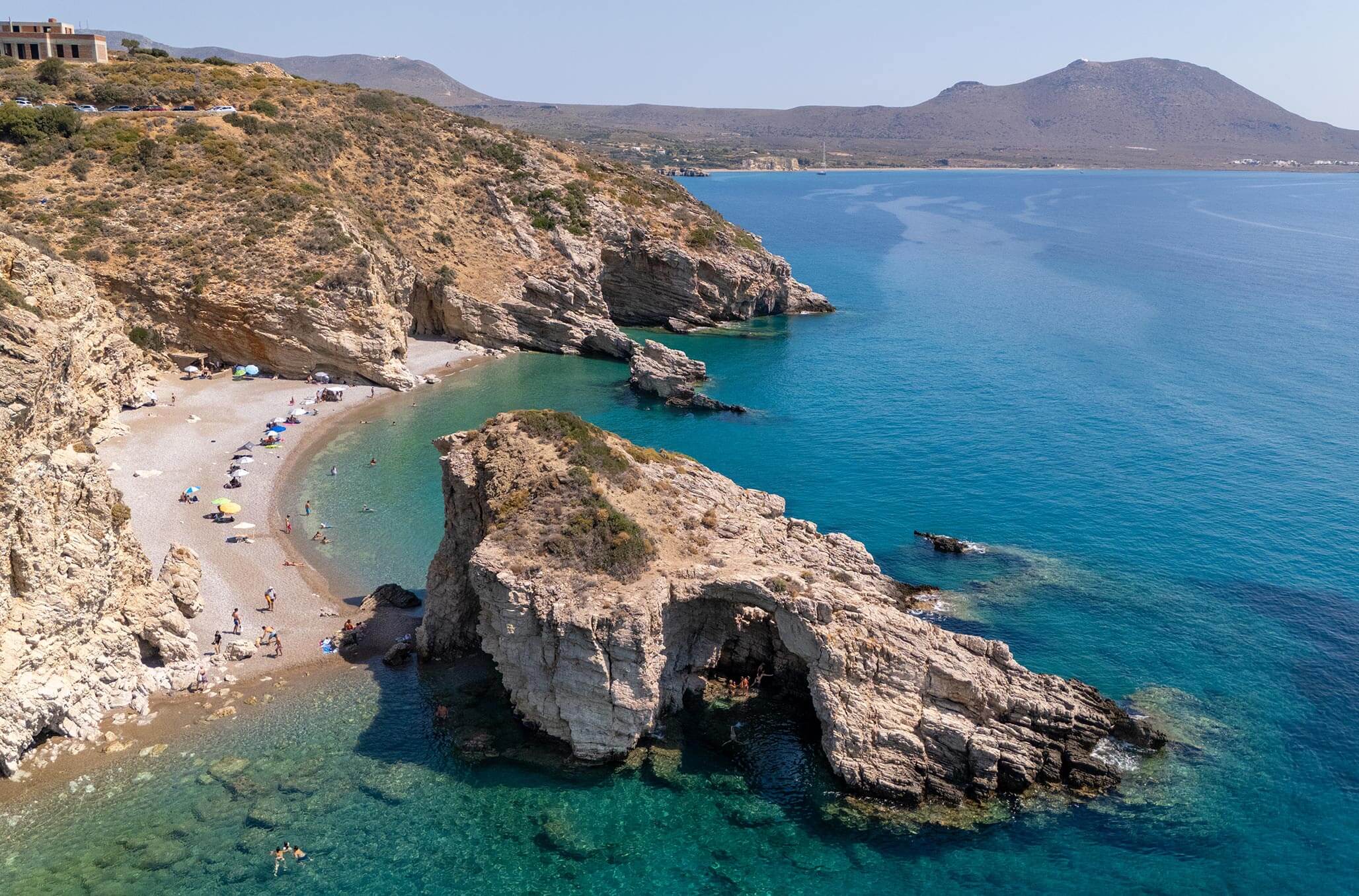
Kythira has beaches where you can park beside the sand, order a coffee and stay until the afternoon. It also has beaches where getting there involves a winding road, a long staircase or, in one case, a fairly demanding hike.
That difference matters when you’re planning your days.
I’m Pantelis, the travel blogger behind Adventourely, and after travelling around Kythira, I wouldn’t recommend choosing beaches from photos alone. The island is spread out, and the beach that looks most impressive online might not be the one you enjoy most if you’re travelling with children, don’t like driving on narrow roads or simply want an easy swim.
For me, the best approach is to mix a few of the island’s more dramatic beaches with places where you can have lunch, explore a village or spend a couple of hours without making the whole day about getting there. That is also how I approached my 4-day itinerary in Kythira, which combines beaches with the villages and sights I think are worth making time for.
Here are the ten beaches I would put on your shortlist, along with the practical details that can make the difference between a good beach day and a frustrating one.
1. Kaladi Beach

Kaladi is probably the beach most people have in mind when they picture Kythira. Steep cliffs rise behind a pebbled shore, and the water takes on that pale turquoise colour that makes you want to get in immediately.
The main beach is actually part of a group of three small beaches. There are sections to either side that can be reached by taking a few steps through the water, although I would only attempt that when the sea is calm and the conditions are safe.
The important thing to know is that Kaladi is not a drive-up beach. You leave the car above the coast and descend around 162 steps to reach it. Going down is straightforward enough for most reasonably fit visitors. Coming back up in the midday heat, carrying a beach bag, is a different matter.
I would bring plenty of water, something to eat and whatever I needed for shade. Kaladi is unorganised, although the cliffs provide some natural shade at certain times of day. There is a canteen and parking area above the beach, but I wouldn’t rely on buying everything I needed once I was down by the water.
One particularly useful detail is the navigation. Search for Kaladi Canteen rather than relying on a generic Kaladi Beach pin, as different map locations can lead to confusion.
I would also avoid making Kaladi the centrepiece of the day when strong easterly winds are forecast. The beach is exposed, and rough water can spoil the swimming. If the weather looks good, I’d aim for the morning or later afternoon, especially in August.
Best for: Dramatic scenery, swimming and anyone who doesn’t mind a staircase.
Access: Around 30 minutes from Livadi, followed by approximately 162 steps.
Facilities: Unorganised beach; seasonal canteen and parking above the beach.
2. Chalkos Beach

Chalkos is one of the beaches I would consider when I wanted a good swim without turning the journey into an expedition. It is around 15 minutes by car from Kapsali, and you can drive down to the beach and park nearby.
The shore is pebbly, with smaller pebbles in the water. The sea is usually clear enough to make bringing a snorkelling mask worthwhile, particularly around the rocks on the right-hand side. That part of the beach also has shallower water.
Chalkos is popular, and its easy access is part of the reason. There is a beach canteen with sunbeds and umbrellas, but you can also use the free section of the beach. I would check the current prices when I arrived rather than planning around an old online price, as beach-bar charges can change between seasons.
What appeals to me about Chalkos is that it doesn’t require much planning. You can spend the morning swimming, have something to eat and still have time to visit Chora or Kapsali later in the day. It is a particularly sensible choice if you are staying in the south of the island.
Best for: An easy beach day, snorkelling and combining swimming with sightseeing.
Access: Approximately 15 minutes from Kapsali, with parking close to the beach.
Facilities: Seasonal canteen, sunbeds and umbrellas, plus free space for towels.
3. Fyri Ammos

There are two beaches called Fyri Ammos in Kythira, so make sure you are heading to the one near Kalamos rather than the beach near Agia Pelagia.
The Kalamos beach is one of the largest and most striking on the island. It has reddish pebbles, a wide shoreline and cliffs rising behind it. Unlike some of Kythira’s smaller coves, there is enough space here to spread out without feeling that you need to arrive first to claim a spot.
The drive from Kalamos takes roughly ten minutes, but the final road is narrow and winding. You park above the beach and walk down a short slope. I would take that last section slowly rather than letting the view distract me from the road.
There is a small seasonal canteen with sunbeds and umbrellas, as well as a shower and changing area. The beach also has plenty of room for visitors bringing their own towels and shade. Later in the day, the cliffs can provide some natural shade, although I would still bring sun protection.
The right-hand end of the beach is especially interesting for swimming. There are rocks and cave-like formations along the coast, so it is worth bringing a mask if you enjoy exploring underwater. I would only swim towards them in calm conditions and stay well within my abilities.
Best for: A long beach day, space to spread out and snorkelling.
Access: Around ten minutes from Kalamos, followed by a short walk downhill.
Facilities: Seasonal canteen, sunbeds, umbrellas, shower and changing area.
4. Limnionas Beach

If I were spending the day around Mylopotamos, Limnionas would be a natural place to finish with a swim.
The beach sits inside a small bay on Kythira’s western coast, less than 20 minutes from the village. It has sand mixed with some stones, clear blue water and a handful of old fishermen’s houses close to the shore. Small boats are moored along the waterfront, which gives the place a different feel from the island’s larger beach-bar beaches.
The road down is asphalted, but the final section has several tight bends and can feel narrow. You can drive all the way to the beach, where there is a parking area.
There is a small seasonal canteen, a few sunbeds and some tables, but much of the beach remains free. Tamarisk trees provide shade in places. I would still bring water and a few supplies, particularly if I planned to stay for several hours.
Limnionas is not the beach I would choose for a huge stretch of sand or lots of facilities. I would choose it because it works so well with a slower day in western Kythira. Visit Mylopotamos, explore the village and its surroundings, then head down to the sea when you are ready to stop walking.
Best for: A quieter swim and combining the beach with Mylopotamos.
Access: Less than 20 minutes from Mylopotamos, with parking at the beach.
Facilities: Small seasonal canteen, limited sunbeds and natural shade.
5. Avlemonas

Avlemonas is one of the places I would recommend even to someone who doesn’t usually spend much time on beaches.
The swimming spot is a small, sheltered cove surrounded by rocks, with clear turquoise water and very little conventional beach space. You enter the sea using the steps or platforms around the cove, so it feels more like swimming in a natural pool than laying out on a long sandy beach.
That is also why I wouldn’t plan to spend an entire day here with a towel and umbrella. There simply isn’t much room. I would come for a swim, dry off and then spend some time in the village.
Avlemonas has restaurants, cafés and a small waterfront that is pleasant to walk around. I especially like the idea of combining a swim here with lunch rather than driving somewhere else as soon as I get out of the water. It is one of the easiest ways to make a beach stop feel like part of the day rather than another destination to tick off.
If you are travelling with someone who prefers sitting in a café to spending five hours on a beach, Avlemonas is a good compromise.
Best for: A short swim, couples and combining the sea with lunch.
Access: In Avlemonas village, between Diakofti and Chora.
Facilities: Restaurants and cafés nearby; limited space for towels and no conventional organised beach.
6. Kalami Beach

Kalami is one of Kythira’s most dramatic beaches, but it is also one of the most difficult to reach. I would only put it on my itinerary if I genuinely wanted the hike and was comfortable with the access.
The beach lies at the end of a gorge on the western side of the island, around four kilometres from Mylopotamos. It is small, mostly pebbly and surrounded by steep rock faces.
To reach it, you leave your vehicle near the Monastery of Panagia Orfani and follow the trail towards the coast. The walk takes roughly 15–20 minutes, but the final section is the part that requires serious attention. It involves a steep descent over rock, with a rope provided along the difficult section.
This is not a place I would recommend for young children, anyone uncomfortable with heights or visitors who are not reasonably fit. Wear proper closed shoes, preferably hiking shoes, and do not attempt the descent in unsuitable weather or if you are unsure about the conditions. A rope being present does not automatically make a route safe.
There are no facilities at Kalami, so you need to carry everything you require, including enough water for the return hike.
I can understand why people make the effort to get here. The setting is unusual, and the beach feels very different from Kythira’s more accessible bays. But I would rather be clear about the difficulty than send someone there expecting a simple 20-minute walk.
Best for: Experienced, confident hikers who want a more remote beach.
Access: Trail from Panagia Orfani Monastery, with a difficult final descent.
Facilities: None.
7. Diakofti Beach

Diakofti is the beach I would look at first if I were travelling with young children or wanted a day where everything was easy.
It is beside Kythira’s main ferry port and has fine, pale sand and shallow water. The sea is generally calm, and the beach is much easier to access than the rocky or steep-sided beaches elsewhere on the island.
There are sunbeds and umbrellas in several areas, along with places to eat, a shower and seasonal water-sports facilities. You can drive right down to the beach, which makes it especially convenient if you are carrying children’s beach equipment or simply don’t want a long walk.
Diakofti is also useful on an arrival or departure day. If you are travelling by ferry and have a few hours before checking in or leaving the island, you can fit in a swim without driving across Kythira first.
I wouldn’t choose Diakofti for the same reason I would choose Kaladi. Its appeal is the sand, shallow water and convenience. Sometimes that is exactly what you want.
If you are still deciding how to reach the island, my guide to getting to Kythira compares the ferry routes from Piraeus, Neapoli, Gytheio and Kissamos, as well as flights from Athens. It also explains the route I chose for my own trip.
Best for: Families with young children, easy swimming and arrival-day beach stops.
Access: Beside the main ferry port, with easy road access.
Facilities: Sunbeds, umbrellas, food options, shower and seasonal water sports.
8. Kapsali Beach

Kapsali sits directly below Chora, around ten minutes away by car. It is one of the most convenient beaches on the island if you are staying in the capital or spending the day exploring its streets and castle.
The beach has sand and pebbles, clear water and a good amount of space. There are organised sections with sunbeds and umbrellas, but also areas where you can put down your own towel. Restaurants and cafés line the settlement behind the beach, so you don’t need to bring a full day’s worth of food.
I like Kapsali as an option for the days when you don’t want to plan too much. You can spend the morning in Chora, come down for a swim and stay for dinner if you feel like it. It is also a sensible choice for families or anyone who prefers easy access and facilities.
If the main beach feels too busy, nearby Sparagario is another option. It is smaller and quieter, and can be reached on foot from Kapsali or by canoe. It is also known as a beach used by naturists, so it may not be the right choice for everyone.
Kapsali is a good example of why I think choosing your base matters in Kythira. If you want to walk out for dinner after a beach day, Chora and Kapsali offer a different experience from staying in a more isolated part of the island. I’ve compared the main areas in my where to stay in Kythira guide, including which ones I would choose for a first visit, families and a more relaxed seaside holiday.
Best for: Easy access, families and combining swimming with Chora.
Access: Around ten minutes by car from Chora.
Facilities: Sunbeds, umbrellas, restaurants, cafés and water-sports options.
9. Paleopoli Beach

Paleopoli is the longest beach in Kythira, so it is worth considering if you prefer a broad stretch of coast to a small cove.
It lies on the eastern side of the island, around 1.5 kilometres from Avlemonas. The beach has sand and fine pebbles, with organised sections offering sunbeds and umbrellas. There is also a large parking area, and the source information notes an access ramp for people with disabilities.
The main thing I would check before heading here is the wind. Paleopoli is exposed to several wind directions, including northerly, northeasterly and southeasterly winds. If the forecast looks unfavourable, I would keep it as a flexible option rather than committing to a full day.
When the conditions are good, though, the amount of space is a real advantage. I would also consider combining Paleopoli with Avlemonas, as the two are close enough to make a convenient beach-and-village day.
Best for: Visitors who prefer a long beach and easy road access.
Access: Around 1.5 kilometres from Avlemonas, with parking near the beach.
Facilities: Organised sections with sunbeds and umbrellas; access ramp reported in the supplied information.
10. Melidoni Beach

Melidoni is on Kythira’s western coast, around 20 minutes from Livadi. It is a small bay with fine pebbles, clear water and rocks around the sides that provide some protection from the wind.
The road is asphalted but winding, so I would allow a little extra time rather than judging the journey only by the distance. You can drive down to the beach, where there is a parking area.
There is a seasonal beach bar with sunbeds and umbrellas, as well as a shower. The beach is also known for a zip line that crosses above the bay. If that is something you want to try, I would check whether it is operating and confirm the current price before visiting rather than relying on information from a previous summer.
Melidoni can get busy, particularly in peak season. I would arrive early if I wanted a good choice of space, or consider going later in the afternoon.
What makes it useful for a short trip is that it gives you another option on the western side of the island. If the wind is making an exposed beach less appealing, Melidoni may be worth checking, although I would still look at the actual sea conditions before swimming.
Best for: A sheltered bay, beach-bar facilities and a more active beach day.
Access: Around 20 minutes from Livadi, with parking at the beach.
Facilities: Seasonal beach bar, sunbeds, umbrellas and shower; zip line when operating.

